 PhoneCodex
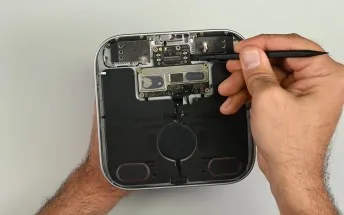
Apple put the HomeView on sale on 13 November. iFixit had one open by the 17th, and the write-up that came out of it is titled "A Surprising Step Backward". Having read it, the title is doing a lot of restraint.
The HomeView is a $299 smart home hub with a 7-inch square Liquid Retina display, 1088 by 1088 at 220 pixels per inch, sold either as a tabletop unit with a speaker base or as a wall-mounted panel. Inside is an A18, 8GB of SK hynix LPDDR5X and what iFixit reckons is 64GB of Kioxia storage. It is mains powered, so there is no battery to degrade, which ought to make it one of the easier things Apple sells to keep alive.
It is not. The adhesive holding the display down, iFixit says, "held on harder than on any Apple product we've opened recently". Thick pads of glue sit under the speakers. The speaker connectors are superglued to the board. The thermal shield over the logic board is glued in place so thoroughly that the team "put more force on the poor logic board than any of us were comfortable with" getting it out.
One of the display speakers did not survive. After an isopropyl soak and some prying it snapped in two, which iFixit recorded with the line "Failure mode analysis complete. Result: it done broke."
The two halves do not come apart
The single worst finding is structural. The screen assembly and the base cannot be separated from each other without going in through the display side first, and the display side is the glued part. iFixit's wording: "you literally cannot separate the two halves of HomeView without either specialized tools or completely (and most likely destructively) disassembling the screen side."
The pivot that joins them is held by Torx screws that are both torqued down and threadlocked, set at an off angle, with the cables routed through the pivot before those screws went in. That is an assembly order that works beautifully on a production line and cannot be run backwards by a human with a screwdriver.
There are smaller irritations stacked on top. One bracket takes a Phillips screw at one end and a Torx at the other, which iFixit calls "a poor choice" and which means two drivers for one part. The connectors are the brittle kind that rip out of their plastic housings, a design iFixit has complained about on the Steam Deck and the M4 Mac mini. The woofer has a cable so short that the team were left "wondering how anyone connected its extremely short cable to the board underneath".
What you can actually fix
The base is the good news, and it is genuinely good. Peel the pad off the bottom, undo four Torx screws and the plate comes away. The USB-C port is modular and replaceable. The two passive radiators inside would be easy to swap. The power supply board pops free after a few screws and a couple of connectors. The left and right microphones came out, in iFixit's words, "without any surprises".
The split is clean and a bit damning: the half of the product that Apple built like a HomePod is serviceable, and the half it built like a tablet is not. iFixit makes the comparison itself, noting that the original HomePod needed a hacksaw to open but the HomePod 2 could be opened "without destroying anything", and that the iPad has been getting steadily easier to fix, with simpler battery access, a replaceable USB-C port and official repair manuals.
No numeric score was given. iFixit does not run its 1 to 10 scale on this category of device, and the only figure anyone offered was Shahram Mokhtari's unprintable joke about what he would award it. Treat that as a mood rather than a rating.
Two more things worth knowing. The tabletop and wall-mounted versions are not interchangeable inside, since the wall unit carries a wider logic board and extra magnets while the tabletop has the larger speakers and the pivot. And whether Apple will sell HomeView parts or manuals through Self Service Repair has not been stated anywhere, by Apple or anyone else. Apple has not commented on the teardown.
The sentence from iFixit that will stick is not about glue at all. "Designing for repair is an intentional act, and here, Apple didn't bother." The team's other line lands harder: "Nobody at Apple fought for the day a HomeView breaks."












What readers are sayingComments
Loading comments…