 PhoneCodex
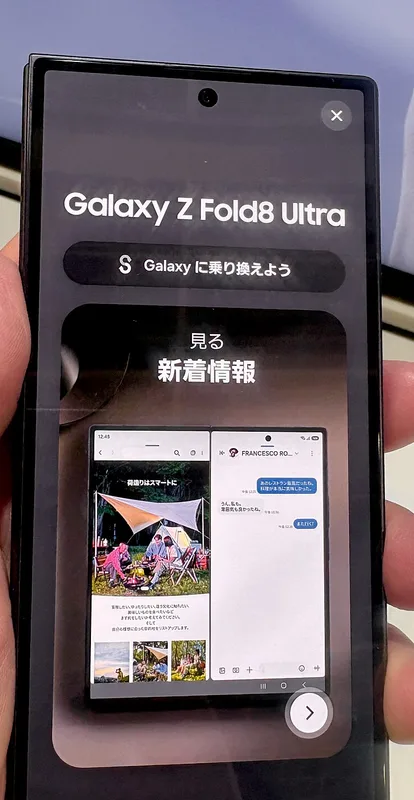
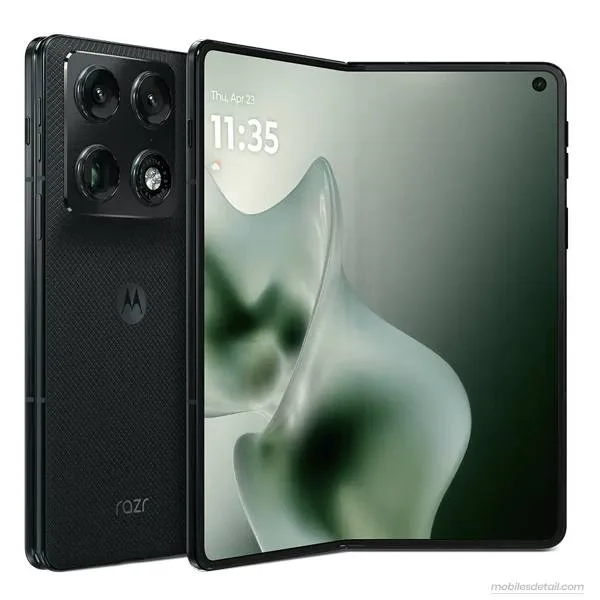
The book-style foldable market has a new contender. Motorola, after years of making flip foldables with the Razr series, has entered the big-screen foldable space with the Razr Fold. It goes directly against Samsung's Galaxy Z Fold 8 Ultra, which has had this category largely to itself for years. Both phones unfold into tablet-sized screens. The details are where they differ.
Specifications at a Glance
| Spec | Z Fold 8 Ultra | Razr Fold |
|---|---|---|
| Inner Display | 8.0" AMOLED, 3000 nits | 8.1" OLED, 6200 nits |
| Cover Display | 6.5" AMOLED | 6.6" pOLED, 165Hz |
| Chipset | SD 8 Elite Gen 5 for Galaxy (3 nm) | SD 8 Gen 5 (3 nm) |
| Water resistance | IP48, 1.5 m for 30 min | Not published in our sources |
| Video | 8K at 30fps, 4K at 120fps | 4K at 60fps |
| Main Camera | 200 MP f/1.7 | 50 MP (wide) |
| Battery | 5,000 mAh | 6,000 mAh |
| Charging | 45W wired | 80W wired |
| Weight | 215 g | 244 g |
| Thickness (folded) | 8.9 mm | 9.9 mm |
| Price | $2,099.99 | $1,899 |
Display
Motorola wins the brightness battle convincingly. The Razr Fold's inner display hits 6,200 nits and its cover display reaches 6,000 nits. Samsung's Z Fold 8 Ultra tops out at 3,000 nits inside. In bright outdoor conditions, the Motorola is significantly easier to read.
The cover displays tell a similar story. Motorola's 6.6-inch cover runs at 165Hz, while Samsung's 6.5-inch cover uses standard 120Hz. Both are usable as standalone phone screens, but the Motorola's cover display feels more responsive.
Samsung's Z Fold 8 Ultra is thinner when folded at 8.9mm versus 9.9mm, and lighter at 215 grams versus 244 grams. These differences matter because foldable phones spend most of their time folded. The Samsung feels more like a regular phone in the pocket.
Camera
Samsung has a significant camera advantage. The 200MP main sensor with a 1/1.3-inch size is in a different league from Motorola's 50MP camera. The Samsung captures more detail, handles low light better, and provides more flexibility for cropping. Samsung also offers 8K video recording, which the Motorola cannot match.
Motorola's triple 50MP system is competent but cannot compete with Samsung's hardware in difficult shooting conditions. For anyone who uses their foldable as their primary camera, Samsung is the clear choice.
Battery and Charging
Motorola packs a 6,000mAh silicon-carbon battery, 20% larger than Samsung's 5,000mAh cell. Combined with 80W wired charging versus Samsung's 45W, the Razr Fold charges faster and lasts longer. Motorola also offers 50W wireless charging, more than double Samsung's 20W.
Software and Ecosystem
Samsung's foldable software is more mature. DeX desktop mode, multi-window management, and app continuity between the cover and inner displays are all refined through years of iteration. Motorola is newer to the book foldable format, and its software, while functional, lacks some of the polish Samsung has built up over six generations.
The version gap reinforces it. The Z Fold 8 Ultra ships on Android 17 with One UI 9. The Razr Fold ships on Android 16. Samsung is a full OS release ahead out of the box.
Design, Hinge and Dimensions
Unfolded, the Samsung measures 158.4 x 143.2 x 4.1 mm. The Motorola measures 160 x 144.5 x 4.6 mm. Both are extraordinarily thin when open, and 4.1 mm is thin enough that the phone feels structurally improbable the first time you hold it.
Folded is where the gap opens. Samsung closes to 8.9 mm at 215 grams. Motorola closes to 9.9 mm at 244 grams. That is a full millimetre and 29 grams, and because a book foldable spends most of its life closed, this is the difference you live with rather than the one you show people.
Samsung's build uses Gorilla Glass Ceramic 3 on the cover screen, Gorilla Glass Victus 2 on the back and an aluminium frame. Motorola has not published an equivalent materials breakdown in the sources we verify against.
Durability and Water Resistance
This is the most important section in the comparison and the one most easily skipped.
The Galaxy Z Fold 8 Ultra carries an IP48 rating, certified for immersion up to 1.5 metres for 30 minutes. The 4 in that rating refers to dust: it blocks particles larger than 1 mm, which is the realistic ceiling for a device with a hinge, but it is not sealed against fine dust or sand.
Our verified sources do not list any ingress protection rating for the Motorola Razr Fold. That does not prove the phone has none, but on a device costing $1,899 with a mechanical hinge and a plastic inner display, an unpublished rating is something to confirm with Motorola before you buy rather than assume.
The Unfolded Screen Shape
Inner display dimensions matter more than inner display size on a foldable, because the aspect ratio decides what the screen is actually good for.
Samsung's 8.0-inch panel runs 2256 x 2504 at roughly 422 ppi, which is close to square and slightly taller than it is wide. Motorola's 8.1-inch panel runs 2484 x 2232, which is slightly wider than it is tall. Samsung's shape suits reading, documents and stacked split-screen work. Motorola's suits video, which pairs neatly with its Dolby Vision support.
Both cover screens are 21:9. Samsung's is 6.5 inches at 1080 x 2520; Motorola's is 6.6 inches at 2520 x 1080. The resolutions are identical; the refresh rates are not, with Motorola at 165Hz against Samsung's 120Hz.
Cameras in Detail
Samsung's advantage is not only the 200 MP headline. The full rear system is a 200 MP f/1.7 24mm wide with a 1/1.3-inch sensor and OIS, a 10 MP f/2.4 67mm telephoto with 3x optical zoom and OIS, and a 50 MP f/1.9 120-degree ultrawide, all with phase-detect autofocus.
Motorola fits three 50 MP sensors: a stabilised wide, an ultrawide and a 3x telephoto that extends to 100x digitally. On paper it is the more balanced set. In difficult light the sensor size difference on the main camera decides it in Samsung's favour.
Front cameras invert the result. Motorola uses a 32 MP cover camera and a 20 MP inner camera. Samsung uses a 10 MP cover camera and a 10 MP under-display inner camera. Under-display sensors trade image quality for an uninterrupted screen, and Samsung's inner selfie camera is visibly the weakest camera on either phone. If you take a lot of selfies or spend your day on video calls, Motorola is the better choice here by a wide margin.
Video is a clear Samsung win. The Z Fold 8 Ultra records 8K at 30fps, 4K at up to 120fps and 1080p at up to 240fps, with 10-bit HDR and HDR10+ throughout. The Razr Fold caps at 4K 60fps and 1080p 120fps.
Performance, Memory and Connectivity
The chipsets are not the same tier despite both being 3 nm parts. Samsung uses the Snapdragon 8 Elite Gen 5 for Galaxy, with two Oryon V3 Phoenix L cores at 4.74 GHz, six Phoenix M cores at 3.62 GHz and an Adreno 840 GPU. Motorola uses the Snapdragon 8 Gen 5, a step below it in Qualcomm's range.
Memory goes the other way at the entry point. Motorola ships a single configuration: 512 GB with 16 GB of RAM. Samsung starts at 256 GB with 12 GB and only reaches 16 GB on its 512 GB and 1 TB tiers. If you compare base models, Motorola gives you twice the storage and more memory.
Samsung's connectivity is the broader package: tri-band Wi-Fi 7, Bluetooth 6.0 with aptX HD, Ultra Wideband, NFC and USB-C 3.2 Gen 1 with OTG. Motorola has Wi-Fi 7, Bluetooth 5.4 and NFC, with no UWB listed. Both use side-mounted fingerprint readers, which is the sensible choice on a folding device.
Price and Configurations
The Galaxy Z Fold 8 Ultra starts at $2,099.99 for 256 GB with 12 GB of RAM. The Motorola Razr Fold is $1,899 for 512 GB with 16 GB of RAM.
Compared like for like, the gap is wider than the $200 headline. Samsung's 512 GB tier costs more again, so the Motorola undercuts it by a larger margin at matching storage. What the extra Samsung money buys is the better camera, the better chip, a published water resistance rating, a thinner and lighter folded body and six generations of foldable software refinement.
Who Each Foldable Is Actually For
The Galaxy Z Fold 8 Ultra is for someone replacing a flagship slab phone with a foldable and refusing to give anything up in the process. It takes the best photographs of any foldable, it is the thinnest and lightest when closed, it has a published water resistance rating, and One UI's multitasking is six generations ahead of anything else in the category. It is also the most expensive phone in this comparison by $200 at the entry tier and more than that at matching storage.
The Motorola Razr Fold is for someone who wants the large screen without the Samsung tax, and who watches more than they photograph. The 6,200-nit inner display and Dolby Vision support make it the better media device, the 6,000 mAh battery and 80W charging make it the better travel device, and the 512 GB with 16 GB base configuration is more generous than Samsung's entry model. The unlisted water resistance rating is the question to settle before buying.
Related Reading
If a foldable is a want rather than a need, the same money buys a lot of conventional flagship. Our Galaxy S26 Ultra review covers Samsung's slab flagship, which shares the same chipset and a comparable camera system for several hundred dollars less, and the S26 Ultra versus iPhone 18 Pro Max comparison sets it against Apple.
Which One to Buy
Buy the Z Fold 8 Ultra if you want the best camera on a foldable, the thinnest and lightest design, and the most mature foldable software experience. It costs more, but Samsung's multi-year lead in foldable development shows.
Buy the Razr Fold if you want a brighter display, longer battery life, faster charging, and a lower price. Motorola's first book foldable is impressive, and the $200 savings over Samsung is meaningful.