 PhoneCodex
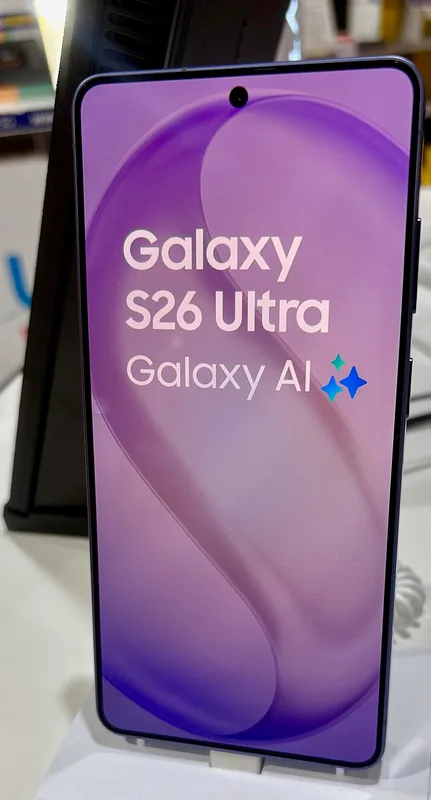
The Galaxy S26 Ultra is not a phone that tries to surprise you. It is a phone that tries to be better at everything the S25 Ultra already did well, and for the most part, it succeeds. The camera is sharper, the display is brighter, the chip is faster, and the whole thing feels like it was assembled by people who genuinely care about tolerances.
That might sound boring. It is not. When a phone gets this many things right simultaneously, the cumulative effect is something that feels genuinely premium in a way that spec sheets cannot fully communicate.
Display
The 6.9-inch Dynamic LTPO AMOLED 2X panel is excellent by any measure. Samsung has pushed peak brightness to 2,600 nits, which makes outdoor readability a non-issue even in direct sunlight. The 120Hz refresh rate adapts smoothly between 1Hz and 120Hz depending on content, and the 1440x3120 resolution keeps text razor-sharp at any zoom level.
The standout feature here is Samsung's Privacy Display technology. When enabled, it narrows the viewing angle so that people sitting next to you on a train or in a meeting cannot read your screen. It works surprisingly well. The effect is noticeable but not jarring, and it turns off automatically when the phone detects you are the only person looking at it.
Performance
The Snapdragon 8 Elite Gen 5 for Galaxy is Qualcomm's latest 3nm flagship chip, and Samsung gets a custom-tuned version with slightly higher clock speeds than the standard variant. In practice, this means the S26 Ultra handles everything from basic messaging to 8K video editing without hesitation.
Samsung offers the phone in 12GB/256GB, 12GB/512GB, and 16GB/1TB configurations, all with UFS 4.0 storage. The 16GB model is the one to get if you plan to keep the phone for several years. One UI 8.5 makes reasonable use of the extra RAM for app caching, and Android 16 benefits from it during multitasking.
Sustained performance under load is solid. Gaming sessions that push the GPU hard will eventually trigger thermal management, but the throttling is gradual rather than sudden, and the phone never gets uncomfortably hot in hand.
Camera
The headline is the 200MP main sensor with an f/1.4 aperture. That wide aperture pulls in significantly more light than the f/1.7 on most competitors, and the difference is visible in low-light photography. Night shots have less noise, faster shutter speeds, and better natural bokeh than any previous Galaxy phone.
The quad camera setup covers every focal length you would reasonably need. The 50MP ultrawide captures 120-degree shots with minimal distortion at the edges. The 10MP 3x telephoto handles portrait-distance shots. The 50MP 5x periscope telephoto is the one for distant subjects, and it produces usable images all the way up to about 15x. Beyond that, Samsung's Space Zoom processing tries its best, but anything past 30x is more novelty than photography.
Video recording tops out at 8K at 30fps, which is overkill for most people but useful for videographers who want maximum flexibility in post. The 4K 60fps mode is where most users should live. Stabilization is excellent across all modes.
The f/1.4 aperture is not a spec-sheet flourish. It is the first Galaxy camera change in years you can see without pixel-peeping.
On the 200MP main sensorBattery Life
The 5,000mAh battery is the one area where the S26 Ultra does not lead its class. Chinese competitors like the OnePlus 16 are shipping with 9,000mAh cells, and even some mid-range phones now exceed 6,000mAh. Samsung sticks with 5,000mAh, and while the efficiency of the Snapdragon 8 Elite Gen 5 helps, heavy users will still need to charge before the end of the day.
Moderate users will get through a full day comfortably. The 60W wired charging is a welcome upgrade from previous generations, taking the phone from empty to full in about 45 minutes. Wireless charging tops out at 25W.
Build and Design
The S26 Ultra uses Gorilla Armor 2 on both the front and back, paired with an aluminum frame. At 214 grams and 7.9mm thin, it is slightly lighter than the iPhone 18 Pro Max while being essentially the same physical size. The flat sides and squared corners give it a tool-like feel that some people love and others find sharp in the hand.
The body measures 163.6 x 78.1 x 7.9 mm, which is large but not unwieldy for a 6.9-inch phone. Gorilla Armor 2 is the same material Samsung uses to cut reflections on the display, and in practice the front glass does noticeably better under overhead office lighting than the glossy panels on most rivals.
Connectivity and Everyday Hardware
The sensor and radio package is as complete as you would expect at this price. There is an ultrasonic in-screen fingerprint reader, which remains faster and far more tolerant of wet fingers than the optical readers used on cheaper phones. Ultra Wideband is included, which matters for precise device tracking and for digital car keys on supported vehicles.
Wireless connectivity covers Wi-Fi 7 and Bluetooth 6.0. The USB-C port runs at USB 3.2 speeds, rated at 5 Gbps, so transferring a few hours of 8K footage to a laptop takes minutes rather than the better part of an hour you would spend on a USB 2.0 port. That still trips up plenty of flagships in 2026, and it is worth checking before you buy if you move large files regularly.
Storage is UFS 4.0 across all three configurations: 256 GB with 12 GB of RAM, 512 GB with 12 GB, and 1 TB with 16 GB. There is no card slot on any of them.
Software and Update Support
The phone ships on Android 16 with One UI 8.5 and is upgradable to Android 17 with One UI 9. One UI has matured into a genuinely good Android skin. The settings structure is logical, the multitasking implementation is the most capable on Android, and Samsung's DeX desktop mode is still the only one of its kind that people actually use for work.
The trade-off is volume. A fresh S26 Ultra arrives with a meaningful quantity of pre-installed software, some of it duplicating what Google already provides. Most of it can be removed or disabled, but you will spend the first twenty minutes of ownership doing housekeeping.
Price and Value
This is where the conversation gets harder. The Galaxy S26 Ultra launched at $1,299.99 for the 256 GB model and has since moved to a $1,399.99 US list price. That is a significant amount of money for a phone, and it places the S26 Ultra above the $1,299 iPhone 18 Pro Max and well above the $1,099 Pixel 11 Pro.
What the extra money buys is breadth. No other phone in this price bracket gives you four rear cameras covering 0.6x through 5x optical, a 1 TB storage option, Wi-Fi 7, UWB and a display with a hardware privacy mode. Whether that breadth is worth roughly $300 over the Pixel depends entirely on how many of those boxes you actually tick.
Specifications in Full
| Display | 6.9-inch Dynamic LTPO AMOLED 2X, 1440 x 3120 (500 ppi), 120Hz, Privacy Display, 2,600 nits peak |
|---|---|
| Chipset | Snapdragon 8 Elite Gen 5 for Galaxy (3 nm), Adreno 840 GPU |
| CPU | Octa-core, 2 x 4.74 GHz Oryon V3 Phoenix L + 6 x 3.62 GHz Oryon V3 Phoenix M |
| Memory | 12 GB or 16 GB RAM, 256 GB to 1 TB UFS 4.0 |
| Rear cameras | 200 MP f/1.4 wide, 50 MP 120-degree ultrawide, 10 MP f/2.4 3x telephoto, 50 MP f/2.9 5x periscope |
| Front camera | 12 MP f/2.2 |
| Video | 8K at 30fps, Horizon Lock stabilisation up to 4K |
| Battery | 5,000 mAh, 60W wired, 25W wireless, 4.5W reverse wireless |
| Build | Gorilla Armor 2 front and back, aluminium frame, 163.6 x 78.1 x 7.9 mm, 214 g |
| Software | Android 16 with One UI 8.5, upgradable to Android 17 with One UI 9 |
| Connectivity | Wi-Fi 7, Bluetooth 6.0, NFC, UWB, USB-C 3.2 (5 Gbps) |
| Price | $1,399.99 for 256 GB (launched at $1,299.99) |
Who Should Buy the Galaxy S26 Ultra
Buy it if you want one phone that does not ask you to compromise on anything except battery capacity, and if the zoom range matters to you. The four-camera system is the most flexible on the market, and the f/1.4 main sensor makes the low-light gap over rivals real rather than theoretical.
Skip it if you mostly shoot at 1x and value a smaller phone. The Pixel 11 Pro takes comparable photographs in most conditions, fits in one hand, costs $300 less and is supported for seven years rather than Samsung's standard window. Skip it too if endurance is your priority, because a 5,000 mAh cell is simply no longer competitive against phones shipping 9,000 mAh.
Alternatives Worth Considering
The iPhone 18 Pro Max is the obvious cross-platform rival, and its variable aperture camera is the one hardware feature the Galaxy cannot answer. The Pixel 11 Pro undercuts it on price while matching or beating it on image processing. If endurance drives your decision, the OnePlus 16 carries nearly twice the battery for several hundred dollars less, though its availability outside China is limited. A full side-by-side of the two biggest flagships is in our S26 Ultra versus iPhone 18 Pro Max comparison.
The Verdict
The Galaxy S26 Ultra is the best Samsung phone ever made, full stop. The f/1.4 camera is a genuine leap in low-light photography, the Privacy Display solves a real problem, and the build quality is impeccable. The battery could be larger, and the $1,399.99 starting price is steep, but if you want a polished, no-compromise Android flagship, this is it.